Housing Inventory 2024 vs. 2008: San Diego Housing Market
By
/ July 13, 2024
Even if you didn’t own a home in San Diego during the 2008 housing crisis, you likely remember the turmoil it caused. The crash affected countless lives, and it’s natural to worry about a repeat scenario. However, you can rest easy, as today’s market conditions and housing inventory in 2024 are vastly different from those in 2008. According to Business Insider:
“Though many Americans believe the housing market is at risk of crashing, the economists who study housing market conditions overwhelmingly do not expect a crash in 2024 or beyond.”
Experts are confident in this outlook for several reasons. For the market and home prices to crash, there would need to be an excess of houses for sale. However, the current data shows the opposite: there is an undersupply of homes, even with the inventory growth we’ve seen this year. The housing supply primarily comes from three sources:
Existing Homes: Homeowners deciding to sell.
Newly Built Homes: New home construction.
Distressed Properties: Foreclosures or short sales.
When we examine these sources, it’s clear that today’s market doesn’t resemble 2008. For example, the local market in San Diego has seen a steady demand for homes, supported by the area’s desirable lifestyle and economic opportunities. The supply of existing homes remains tight, new construction is carefully managed, and distressed properties are not flooding the market.
This balanced inventory in San Diego and nationwide contributes to the stability that economists and real estate experts predict. So, while it’s wise to stay informed and cautious, there’s no need to fear a repeat of the 2008 housing crash.
Homeowners Selling Their Homes in San Diego: Housing Inventory 2024
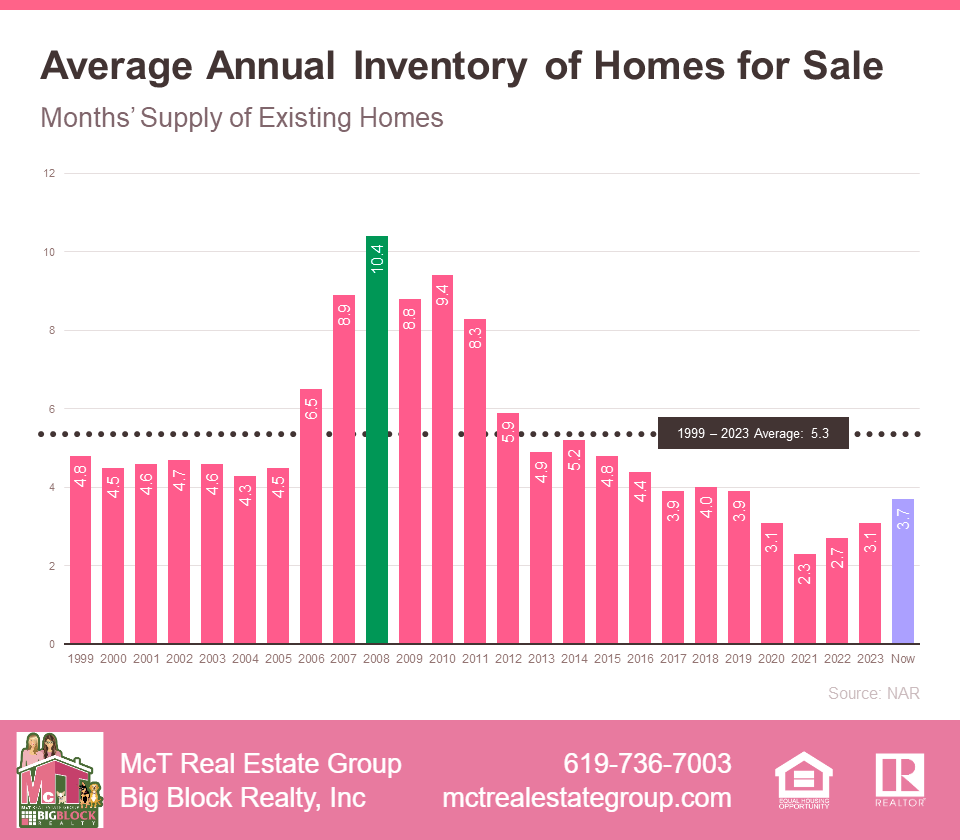
In San Diego, the supply of existing (previously owned) homes has increased compared to last year, but it remains relatively low. While this varies by local market, the national months’ supply is still well below the average and significantly lower than during the 2008 crash.
The graph below illustrates this clearly. The latest data by NAR (shown in purple) compared to 2008 (shown in green) reveals that we currently have only about one-third of the available inventory we had back then.
Average Annual Inventory of Homes for Sale Graph by NAR
So, what does this mean for the San Diego real estate market? Simply put, there aren’t enough homes on the market to cause property values to drop significantly. For a situation similar to 2008 to occur, there would need to be a substantial increase in the number of homeowners selling their properties with very few buyers to match, and that’s not happening right now in San Diego.
This stability in the housing market is reassuring for buyers and sellers, highlighting that today’s conditions are very different from those of the past.
New Home Construction in San Diego: Stability and Growth
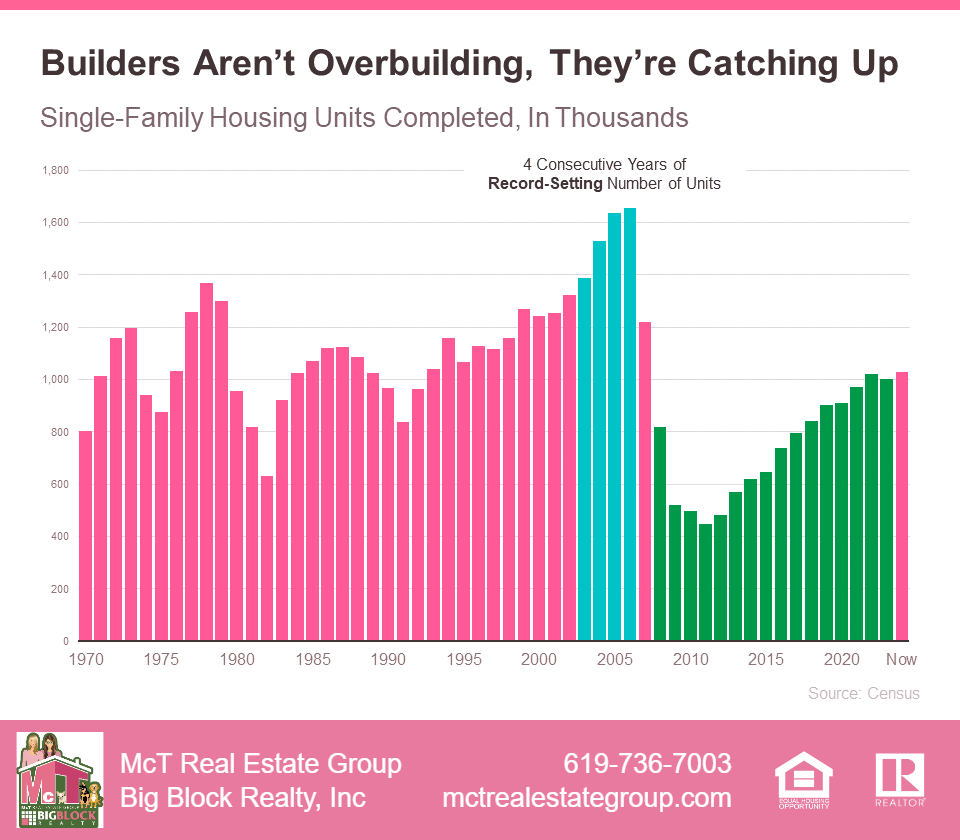
People are buzzing about the new home construction scene in San Diego these days, sparking curiosity about whether homebuilders are going overboard. While new homes represent a larger slice of the total housing inventory this 2024 than usual, there’s no cause for concern. Here’s why.
The graph below, based on Census data, illustrates the number of new homes built over the past 52 years. The blue sections highlight the overbuilding that occurred leading up to the 2008 crash. In contrast, the green areas show consistent underbuilding since then.
Housing Inventory this 2024 – Builders Aren’t Overbuilding, They’re Catching Up Graph by Census
This trend is particularly evident in San Diego. Like builders across the nation, builders here have been cautious, learning from past mistakes. They are not overbuilding but simply catching up to meet the demand.
“What’s more, builders remember the Great Recession all too well, and they’ve been cautious about their pace of construction. The result is an ongoing shortage of homes for sale.”
San Diego’s real estate market, therefore, is in a phase of balanced growth. Builders are strategically increasing the housing supply to meet the needs of our vibrant community without risking another bubble.
Distressed Properties in San Diego (Foreclosures and Short Sales)
Distressed properties, such as short sales and foreclosures, are another source of housing inventory. During the 2008 housing crisis, a flood of foreclosures hit the market because lenient lending standards allowed many people to secure home loans they couldn’t afford. Basically, if you had a pulse, you would be approved for a loan. It was awful and careless.
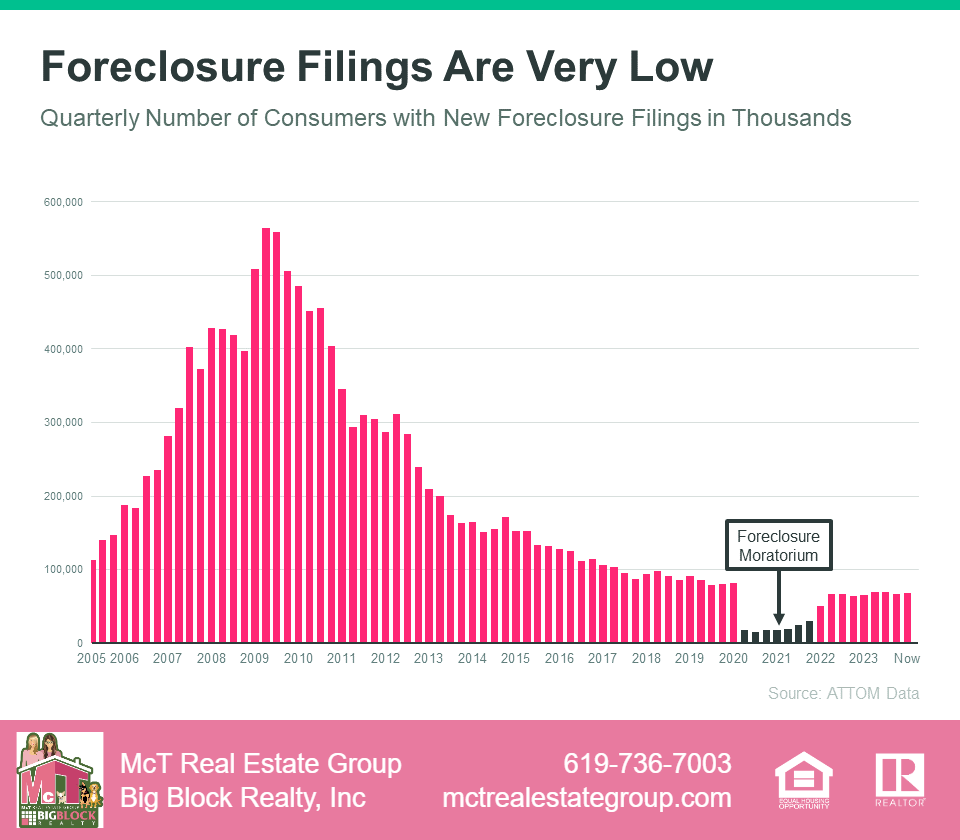
However, today’s lending standards are much stricter, leading to more qualified buyers and significantly fewer foreclosures. The graph below, using data from ATTOM, illustrates the substantial changes since the housing crash:
Foreclosure Fillings Are Very Low Bar Graph by ATTOM
As lending standards became more stringent and buyers more qualified, the number of foreclosures began to decline. The graph also highlights that in 2020 and 2021, a foreclosure moratorium and the forbearance program helped prevent a repeat of the massive foreclosure wave seen during the last market crash.
Although headlines might suggest an increase in foreclosure volume, it’s essential to remember this rise is only in comparison to recent years with minimal foreclosures. We are still below the typical foreclosure levels observed in a normal year.
San Diego, known for its robust housing market, has benefited from these tighter lending standards. The local market remains stable, with fewer distressed properties contributing to inventory. This stability helps maintain property values and supports a healthier real estate environment in the region.
What This Means for You
In San Diego, the housing inventory at the 2024 levels is far from reaching the point where home prices would significantly drop or lead to a market crash.
“As already-high home prices continue trending upward, you may be concerned that we’re in a bubble ready to pop. However, the likelihood of a housing market crash—a rapid drop in unsustainably high home prices due to waning demand—remains low for 2024.”
Mark Fleming, Chief Economist at First American, emphasizes the basic laws of supply and demand, explaining why a crash is unlikely:
“There’s just generally not enough supply. There are more people than housing inventory. It’s Econ 101.”
Similarly, Lawrence Yun, Chief Economist at the National Association of Realtors (NAR), reassures:
“We will not have a repeat of the 2008–2012 housing market crash. There are no risky subprime mortgages that could implode, nor the combination of a massive oversupply and overproduction of homes.”
In the context of San Diego, this is particularly relevant. The city’s desirable location and thriving economy continue to attract new residents, keeping demand high. The limited inventory, coupled with strict lending standards, means that the housing market remains stable. So, if you’re considering buying or selling a home in San Diego, rest assured that the market fundamentals are strong, and a crash is not on the horizon.
Bottom Line on the Housing Inventory 2024 vs. 2008
In San Diego, the housing inventory in 2024 is showing signs of stability that we didn’t see back in 2008. Today, there simply aren’t enough homes for sale to trigger a crisis like we saw back then. With inventory levels remaining low, there is no indication that this trend will change in the near future. Therefore, housing experts and current inventory data consistently indicate that a market crash is not on the horizon.
San Diego’s unique market dynamics, including its desirable location and consistent demand, further support this outlook. Whether you’re buying or selling, it’s reassuring to know that the local market is on solid ground.
For any real estate needs in San Diego, contact the McT Real Estate Group. We’re here to help you navigate the market with confidence and expertise.