

Will San Diego start taxing empty second homes in 2027? If voters approve Measure A on June 2, 2026, property owners with homes vacant for more than half the year could face an $8,000 annual tax, rising to $10,000 the following year.
North Park San Diego homeowners are paying close attention. Whether you own one home or two, this ballot measure could change the math on holding property, renting it out, or selling it. And the debate around it is already getting heated.
Here is what you need to know.
If you are considering your options as a homeowner in 92104, our North Park seller’s guide is a good place to start.
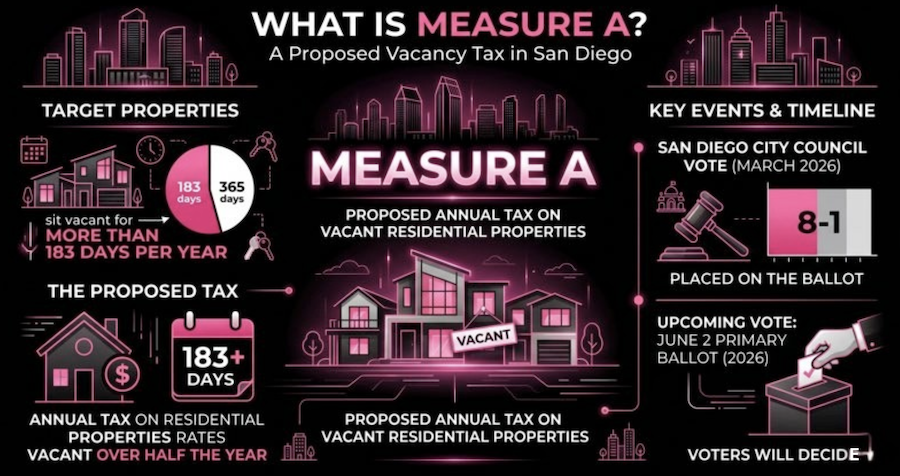
What Is Measure A?
Measure A is a proposed annual tax on residential properties in the city of San Diego that sit vacant for more than 183 days per year. The San Diego City Council voted 8-1 in March 2026 to place it on the June 2 primary ballot.
Councilmember Sean Elo-Rivera introduced the proposal. His argument is straightforward: more than 5,100 homes in San Diego sit empty for most of the year while thousands of residents struggle to find affordable housing.
The tax would apply only to second homes that are not claimed as a primary residence and are not rented out long-term.

How Much Would the Tax Be?
- 2027 (Year 1): $8,000 per vacant home
- 2028 and beyond: $10,000 per vacant home
- Corporate-owned vacant homes: Additional surcharge of $4,000 in 2027, rising to $5,000 in 2028
- Starting in 2029: Both the tax and surcharge would adjust for inflation annually
The city’s Independent Budget Analyst projects the measure could generate between $9 million and $21 million in its first year, and between $10 million and $24 million in the second year. The actual amount depends on how many property owners choose to pay the tax rather than rent or sell. Revenue would go into San Diego’s general fund.
Who Would Pay This Tax?
Not most homeowners. The measure targets a specific group: owners of second homes who leave those properties unoccupied for more than half the year.
According to the city, roughly 5,100 homes currently qualify. About 40 of those are corporate-owned.
Your primary residence is not affected. If you rent your property out, long-term or short-term, it is not affected. This is specifically about homes that sit empty.
Who Is Exempt?
The measure includes several exclusions. You would not owe the tax if your property is vacant because of:
- Active military service
- A natural disaster
- The owner’s death (probate period)
- Long-term medical or care facility stays
- Financial hardship
Why This Matters to North Park Homeowners
Even if you only own one home and live in it, this measure could affect the local housing market around you.
Right now, San Diego County has just 2.2 months of housing supply according to SDAR data from April 2026. A balanced market lasts 5 to 6 months. Anything below three months favors sellers.
If Measure A pushes even a fraction of those 5,100 vacant homes onto the rental or sales market, that is new inventory. For sellers in North Park, that could mean slightly more competition. For the overall market, it could ease some of the supply pressure that has kept prices elevated.
The median sale price for detached homes in San Diego County rose 2.4% year-over-year to $1,100,000 as of early April 2026. In North Park (92104), homes continue to sell quickly when they are priced right. But days on market have been ticking up countywide, indicating that buyers are becoming more selective.
Understanding where the market stands matters if you are thinking about selling. You can get a quick read on your position with a free North Park home valuation.

The San Francisco Warning
Opponents of Measure A are pointing to San Francisco as a cautionary tale.
San Francisco voters approved a similar empty homes tax in November 2022. But in October 2024, a Superior Court judge struck it down, ruling it violated the federal and state constitutions. The city stopped collecting the tax and is now appealing the decision.
Critics argue that San Diego’s Measure A is too similar to San Francisco’s approach and could face the same legal challenges. According to KPBS reporting, a group of realtors and Reform California has already formed committees to fight it. The California Apartment Association has called the measure punitive and said it raises serious legal concerns.
Councilmember Raul Campillo, the lone “no” vote on the council, said he never received a thorough legal analysis showing the tax could survive a lawsuit. That concern remains unresolved heading into the June vote.
Supporters counter that Elo-Rivera’s office hired outside legal experts to review the proposal and that San Diego’s version is structured differently enough from San Francisco’s to withstand legal scrutiny.
What Supporters Say
Housing advocates and several labor unions back Measure A. Their argument comes down to one number: 5,100 empty homes during a housing shortage.
Stephen Russell, president of the San Diego Housing Federation, told the City Council that San Diego has lost more than 60,000 affordable homes since 2000. Not because they were torn down, but because they were priced up beyond what working families can pay.
Council President Pro Tem Kent Lee has said the solution to the housing crisis is not just building new homes. It is also putting the existing ones to use.
The tax does not require anyone to rent their home. But it creates a financial reason to think twice about leaving it empty.
What Opponents Say
Property owners and several industry groups argue the tax goes too far.
The California Apartment Association says the measure penalizes owners for choosing not to rent, which they view as a property right. Some homeowners have called it a “money grab” that would not meaningfully change housing availability since 5,100 homes is roughly 1% of San Diego’s total housing units.
Others worry about enforcement. How does the city prove a home is vacant? What about snowbirds or retirees who travel for several months a year but still consider San Diego home?
Not everyone who owns a 2nd home is rich. Some people may live in other parts of the country while the weather is good, and then once either summer or winter rolls around, they have a place to come to in San Diego. They’ve saved their whole lives in order to do this, and now California wants to punish them.
There is also the concern that legal challenges could cost taxpayers money in attorney fees, especially given what happened in San Francisco.

What This Means If You Own Property in North Park
If you live in your North Park home as your primary residence, Measure A does not apply to you directly. But here are a few scenarios where it matters:
You own a second property in San Diego that you keep vacant. This is the group that would owe the tax. If it passes, you would face $8,000 in 2027 and $10,000 starting in 2028. You could avoid the tax by renting the property long-term, using it as your primary residence, or selling it.
You are thinking about selling your North Park home. If Measure A pushes vacant properties onto the market, that is more inventory for buyers to choose from. In a market with only 2.2 months of supply, that effect would likely be modest. But it is worth watching. Check out the step-by-step guide to selling in San Diego if you are weighing your timing.
You are a landlord in North Park. If your rental is occupied or rented out, you are not affected. The tax targets only truly vacant homes. If you are navigating San Diego’s landlord rules, our guide to tenant rights and rent increases covers the current landscape.
Frequently Asked Questions About San Diego’s Empty Homes Tax
Does Measure A apply to my primary residence in North Park?
No. The tax only applies to second homes that are vacant for more than 183 days per year. If you live in your home as your primary residence, you are not affected.
When would the empty homes tax take effect if voters approve it?
The first tax bills would be sent to qualifying property owners in January 2028, covering the 2027 tax year. The rate starts at $8,000 and increases to $10,000 in subsequent years.
Can this tax be challenged in court?
Possibly. San Francisco’s similar empty homes tax was struck down by a Superior Court judge in October 2024. That case is currently on appeal. Opponents of San Diego’s Measure A have already organized to fight it, and legal challenges are expected if it passes.
How many homes in San Diego would be affected?
The city estimates roughly 5,100 homes are currently vacant for more than half the year. About 40 of those are corporate-owned. The Independent Budget Analyst projects the tax could generate between $9 million and $21 million in the first year. That number could decline over time if the measure successfully reduces vacancies, which is the stated goal.
Will this tax lower home prices in North Park?
That is hard to predict. If some owners choose to sell rather than pay the tax, it could add a small amount of inventory to the market. But 5,100 homes across the entire city is a small percentage of the total housing stock. The effect on any single neighborhood like North Park would likely be minimal.
The Bottom Line for North Park Homeowners
Measure A is one of the most talked-about local issues heading into June. Whether you support it or oppose it, the outcome will shape how San Diego treats vacant property going forward.
If you own a second home that sits empty, the financial calculation changes significantly under this proposal. If you own one home and live in it, the direct impact is zero, but the indirect effects on local inventory and pricing are worth tracking.
The June 2 vote is less than two months away. If you want to understand how your property fits into the current North Park market, start with a conversation.
Call and schedule a phone call today. McT Real Estate Group has been helping North Park homeowners make smart decisions for over 20 years.
Z. McT-Contreras | McT Real Estate Group | DRE #01715784