

Author Updated Page 12/11/25
A buyer’s market is when there is more than seven months’ worth of inventory. If no other houses were put on the market, it would take 7 months or more to sell the current inventory. Another name for this is the absorption rate. During a buyer’s market, the sellers tend to have less negotiating power. Buyers tend to come in at a price lower than the list price. Once they complete their home inspection, they will negotiate more aggressively for repairs and credits.
That said, even when we were in a buyer’s market in San Diego, our listings in North Park, South Park, Mission Hills, and other metro communities were still receiving multiple offers. We were still receiving higher offers than the seller originally asked for. The reason for this is that we prepared the home to look as lovely as possible and better than all of the other homes we were competing with within that price range. Also, together with the sellers, we came up with a strategic market plan.
Because of this, homebuyers who lost out on our listings were sometimes confused. They did not understand why their low-ball offer did not receive a response. They just assumed they would, and the sellers would negotiate. This was not the case. We often still had bidding wars, even in a real estate buyer’s market.
As a buyer, make sure your realtor knows the current market in the specific neighborhood in which you want to buy a home. This way, they will be able to give you the correct information. Not knowing this information can hurt you and your chances of getting into the home you want in the neighborhood that you love.
If you are thinking of buying a home in the North Park, South Park, University Heights, Normal Heights, or other parts of the Metro Neighborhoods in San Diego, contact the McT Real Estate Group. We specialize in these neighborhoods. We will be able to guide you through the process of buying an older, quaint home. These are the types of homes in these neighborhoods, and we are experts in selling them.
What is a Sellers’ Market
A seller’s market is when there are fewer than six months of home inventory. If no other homes were to be put on the market, it would take 0-6 months to sell the current inventory. At the peak of the frenzy, we even saw absorption rates as low as 1.5 months in San Diego’s Metro neighborhoods and the coastal areas.
It is a seller’s market. This is not to say that, just because it is a seller’s market, a seller can overprice their home when putting it on the market, and it will automatically sell. Homes that are overpriced when they first hit the market will sit on the market for months, while other homes that are priced correctly sell right away. Those sellers eventually have to make further price reductions. Buyers will eventually start submitting offers below the reduced listing price. The seller would have made more money had they listed at the market price. They would most likely have had a bidding war in today’s market. The price would have escalated, and they would have made more than they did by listing it overpriced.
Today’s home buyers are smart. They have all of the information at their fingertips. Buyers know when a home is extremely overpriced. They will wait until the price is more realistic before they consider making an offer.
If you are buying or selling a home in the San Diego Metro area, contact the McT Real Estate Group today. We are here to help.
Updated on December 4, 2025
2025 Update: Is San Diego a Buyer’s Market or a Seller’s Market?
When this article was first written, San Diego’s metro neighborhoods were deep in a strong seller’s market.
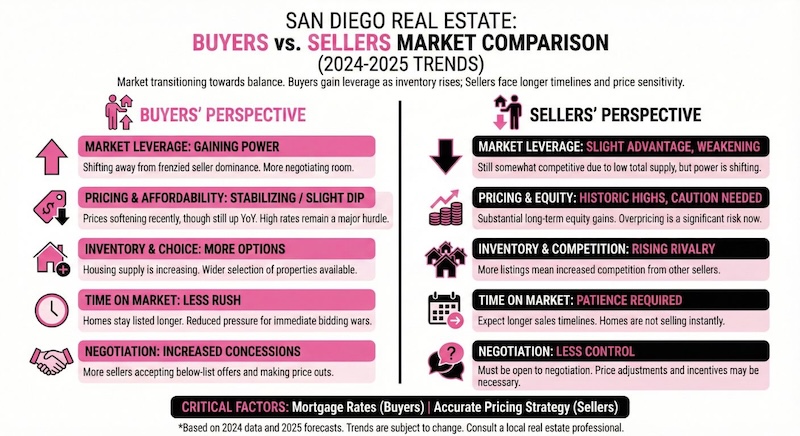
As of late 2025, the overall San Diego housing market is still competitive and leans toward sellers, but higher
mortgage rates and growing inventory have created more balance than we saw a few years ago.
Countywide data shows prices holding relatively firm with some slight softening in certain segments, while inventory has increased compared to the peak of the frenzy. In practical terms, that means buyers have more homes to choose from and slightly more room to negotiate. Though not all neighborhoods are the same, and well-priced homes in popular areas like North Park, South Park, University Heights, Golden Hill, and other nearby communities are still receiving strong interest and multiple offers. Just a few days ago, I wrote an offer for our clients who want to buy a home in North Park. We were competing with six offers at the time.
How to Read the Market in Your Neighborhood
The definitions of a buyer’s and seller’s market in the original article are still accurate: more than seven months
of inventory usually signals a buyer’s market, while less than six months points to a seller’s market. The key in 2025 is that San Diego doesn’t move in one big block. Each micro-neighborhood has its own rhythm.
- Under 3 months of inventory – still a strong seller’s market in that pocket.
- 3–6 months of inventory – a more balanced market where pricing and condition matter a lot.
- Over 6–7 months of inventory – buyers may have more leverage, especially on homes that need work.
Before you assume the whole city is a “buyer’s market” or “seller’s market,” it’s important to look at data for your specific zip code, price point, and property type. Our San Diego Metro Neighborhood Market Report
is a great place to start.
What This Means If You’re Buying in 2025
For buyers, the 2025 market offers more breathing room than the height of the pandemic years, but it’s still not a “free-for-all.” In the central metro zip codes (92104, 92116, 92102), the best-priced homes are still moving quickly.
- Be clear about your budget and your comfort level with payments before you start shopping.
- Watch for price reductions or stale listings that may be more flexible on terms.
- Focus on long-term fit rather than trying to time the market bottom.
If you’d like us to walk you through current numbers for your target neighborhoods, you can always
schedule a quick strategy call.
What This Means If You’re Selling in 2025
Sellers still have a solid advantage in many parts of San Diego, but buyers are more selective than they were at the peak of the frenzy. Instead of assuming “any price will work,” it’s important to combine realistic pricing with strong presentation and targeted marketing.
- Price for today’s market by using recent local sales, not last year’s headlines.
- Make your home the easy choice with professional photos, light staging, and completed minor repairs.
- Have a plan B for small price adjustments or incentives if activity is slower than expected.
Our team has helped homeowners navigate many different market cycles in the metro neighborhoods. We’ll help you decide whether to list now, wait, or reposition your home so it stands out in today’s market.
Request your Free Home Sellers Guide here.
FAQs About the Buyer’s Market in San Diego
- Is San Diego a buyer’s or seller’s market in 2025?
- Overall, San Diego still leans toward a seller’s market in 2025, but higher rates and increased inventory have created a more balanced market. Some neighborhoods feel more competitive than others, so it’s important to look at local data.
- How many months of inventory do you need for a true buyer’s market?
- In general, more than seven months of inventory is considered a buyer’s market. Between three and six months is more balanced, and under three months is usually a strong seller’s market.
- Can buyers still find good opportunities in North Park and South Park?
- Yes. Even in competitive neighborhoods like North Park and South Park, buyers can find good opportunities by watching for price reductions, homes that need light updates, and properties that have been on the market a bit longer.
- What should sellers do differently in a shifting market?
- Sellers should focus on realistic pricing, strong presentation, and flexible terms. Small improvements, good staging, and clear communication with buyers can make a big difference in a market that’s less frenzied than it used to be.
- How can I tell what kind of market my specific neighborhood is in?
- The best way is to look at recent sales, active listings, and months of inventory for your zip code and price range. We can pull a custom report for your home so you can see exactly what’s happening on your streets, not just across the whole county.